Bone marrow biopsies through the years
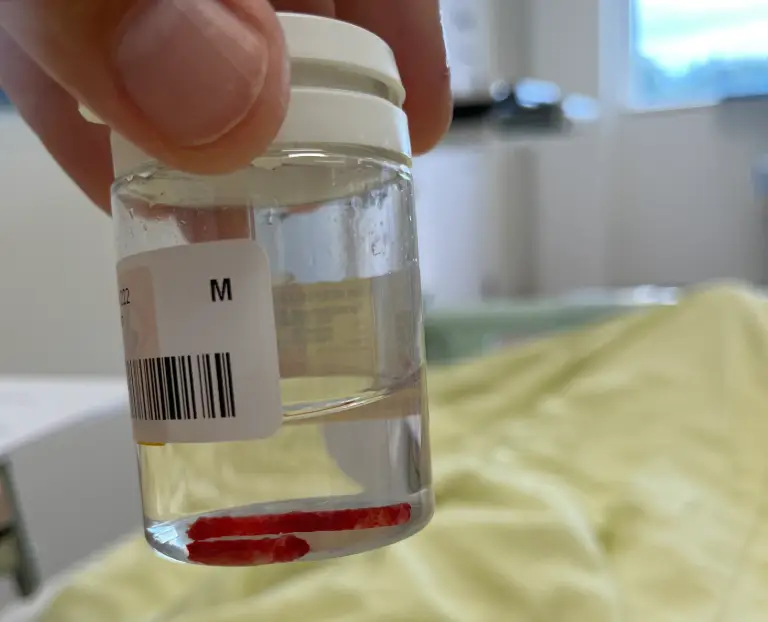
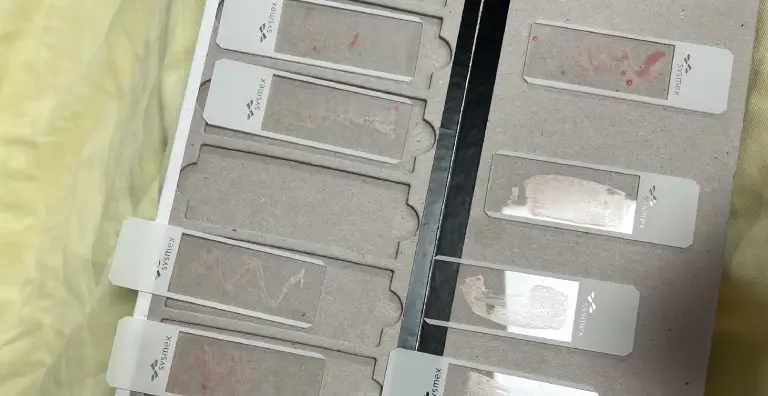
With Waldenström, a bone marrow biopsy (iliac crest biopsy) is occasionally done to check how many abnormal cells are present in the bone marrow. A needle is used to remove a small piece of bone and marrow from the pelvis (see photo below), after which the pathologist examines it under the microscope to assess how many abnormal cells there are and whether it's still the same disease. The percentage of abnormal cells shows whether the disease is becoming more active.
June 2020 – The first biopsy
Done to check whether it was Waldenström or another blood disorder (such as Kahler disease). Under the microscope there were too many abnormal cells present. Staining showed they were all of the same type (kappa), a sign that they are malignant. About 60% of the marrow was taken up by abnormal cells. The diagnosis of Waldenström (also known as lymphoplasmacytic lymphoma or LPL) was confirmed.
October 2023 – Second biopsy, protein rising
The M-protein (mainly IgG) was rising and the Hb was dropping. The abnormal cells were now clustered together and made up about 60% of the marrow. Again confirmed as malignant cells.
October 2024 – Third biopsy, DNA testing
The IgG kept rising while the IgM was actually decreasing. About 70% of the marrow consisted of abnormal cells. Additional DNA testing was done through the UMCG for the MYD88 mutation (L265P), which is characteristic of Waldenström. This mutation was present, confirming the diagnosis at the DNA level as well.
June 2026 – Fourth biopsy, marrow heavily crowded out
The IgG was notably high and the Hb had dropped to 6.7. Now 80% of the marrow consisted of abnormal cells, which had almost completely crowded out the healthy marrow. No new type of lymphoma had appeared: it's the same disease, but now mainly with an IgG character. The fact that the healthy marrow is being crowded out this much explains the low Hb.
Conclusion
The four biopsies over six years show that the abnormal cells have slowly but steadily taken up more space: from about 60% in 2020 and 2023, to 70% in 2024 and 80% in 2026. As a result, the healthy bone marrow, which produces red blood cells, has had less and less room, which is why the Hb has dropped. This is exactly why treatment is now needed.